Wednesday, July 16, 2008

Manzanar

Editor’s Note: The following was originally published in the June/July 2008 edition of Rice Paper the bi-monthly newsletter of the Asian American Drug Abuse Program. It is reprinted here with permission.


by Cory Shiozaki

On February 19, 1942, President Franklin D. Roosevelt signed Executive Order 9066 which gave way to the forced removal of some 120,000 Japanese, two-thirds of whom were born as Americans and imprisoned into ten internment camps without a trial or due process of law.

As early as March 21, 1942, 10,000 of these people were taken to Manzanar. Manzanar was the first of camps located in the remote desert area of the Owens Valley just 220 miles north of Los Angeles. Some internees had as little as forty-eight hours to prepare for their evacuation to these camps, being able to bring only what they could carry. Many had tremendous losses such as their homes, businesses, cars and pets.

The weather at Manzanar was extreme from temperature readings of over 100 degrees during the late spring and summer to freezing cold temperatures in the winter. In many cases it was extremely hot, windy, dusty or cold, making many days unbearable.

The Manzanar National Historic Site, the Manzanar Committee, as well as the Manzanar Pilgrimage clearly are the idealism of Sue Kunitomi Embrey. As a young woman at the age of 19, Sueko (Sue) Kunitomi Embrey, her seven siblings and widowed mother were taken to the Manzanar War Relocation Center in Inyo County under authorization of the 1942 Presidential Executive Order 9066. West Coast Japanese and Japanese Americans were interned shortly after Japan’s attack on Pearl Harbor on December 7, 1941.

Sue describes her first night in the Owens Valley.

“We went through a large building, registered, got a cursory medical examination, a tetanus shot, and were sent out the door. We struggled through the dark and finally got to Block 20. When we walked in, it was a little room, 20x25 feet, with canvas army cots and mattresses filled with hay. My mother sat down on one of the cots and said, in Japanese, ‘Ma konnato ko ni?’ Loosely translated, ‘Mm, a place like this?’”

Embrey, while in camp, got a job weaving camouflage nets for the U.S. Army. She later was a reporter and then editor of the camp newspaper, the Manzanar Free Press. She was in Manzanar for 17 months and 27 days before leaving camp.

Without her as the catalyst, her committee, legal counsel and support of the community, this entire process of Manzanar becoming a national park, educational center and lead in all the camps could never have come about. Several years passed where the idea was looked at as being unpopular and eventually rejected.

Her son, Bruce Embrey, described his mother’s experience.

“My mother worked tirelessly, not just to educate the community, but she did it in a way to bring together and to create an accurate understanding of the period, the tremendous injustice, and racist persecution of an entire community.”

In 1992, Sue Embrey and her committee successfully lobbied Congress to establish the Manzanar National Historic Site. Before that, she and others worked to get the camp’s designation as a State Historic Landmark in 1972 and as a National Historic Landmark in 1985.

Alisa Lynch, National Park Service Chief of Interpretation and Cultural Resources Management, worked closely with Embrey to help create Manzanar into the site it is today.

“The Japanese American community was very disturbed by the publicity.”

Embrey noted about coverage of an early Manzanar Pilgrimage. She added, “Several people came up to me and in no uncertain terms said, ‘Don’t bring up the past and don’t talk about the camps.’”

As a Sansei (third generation born Japanese), I was never told about the “Internment” by my parents, who were incarcerated in two different camps. My mother was sent to Topaz, Utah and my father was sent to Minidoka, Idaho. I was 19 years old and in college when I first learned about internment. I was outraged by this discovery.

My first visit to Manzanar was in 1972 with a group of students from the Asian American Student Alliance while attending Cal State Long Beach. When I arrived there, it was hot, dry, windy, dusty and desolate. I immediately became overwhelmed with mixed feelings of sadness and anger. This experience shaped my future in becoming a filmmaker so I could make a statement to people that something like this should never happen again. My senior film project was about Manzanar, which included Sue Kunitomi Embrey. Currently, I am producing a documentary film of an untold story about internees incarcerated behind barbed wire, who took great risks to sneak out under the noses of armed military guards to go trout fishing in pursuit of brief moments of freedom.

Today, I am the historian for the Manzanar Committee and a docent at the Manzanar National Historic Site and Interpretive Center. I give lectures twice a year while assisting with the previous and this year’s 39th Annual Manzanar Pilgrimage as a committee member. The AADAP staff and Therapeutic Community residents make a pilgrimage to Manzanar on an annual basis. Their journey to Manzanar holds immeasurable value and moves their Spirit each time their feet stand on the Owens Valley. We cannot forget the stories that were told.


Shiozaki is the historian for the Manzanar Committee. He also volunteers as a docent at the Manzanar National Historic Site and is conducting research on former Manzanar internees who snuck out of camp to go trout fishing in the nearby streams. For further information, please visit his website, fearnotrout.com.

Manzanar watchtower photo courtesy of Cory Shiozaki.

The views expressed in this piece are those of the author, and are not necessarily those of the Manzanar Committee.

Monday, July 7, 2008

Manzanar NHS: Merritt Park Archeological Dig: July 21-August 1; August 30-September 2, 2008

Editor’s Note: The following is a press release from the National Park Service.


National Park Service
U.S. Department of the Interior
Manzanar National Historic Site
PO Box 426
5001 Highway 395
Independence, CA 93526
(760) 878-2194 voice
(760) 878-2949 fax

FOR IMMEDIATE RELEASE
June 30, 2008
Contact: Gretel Enck
Phone: (760) 878-2194, ext. 2713

Nishi Family Joins Volunteers At Manzanar NHS To Excavate Merritt Park

Have you ever wondered what it would be like to go back and visit a childhood home? What if that home was a wartime camp behind barbed wire? What if your reason for going back was an archeological excavation of a garden your father built?

This was the experience of the Nishi family on a breezy Saturday in May as they returned to an old family home. Three generations traveled from Los Angeles to Manzanar National Historic Site to participate in the Merritt Park Archeological Dig. The goal of the excavation is to uncover and stabilize rock gardens and features of this centerpiece of community life at Manzanar. The project, which teams park archeologists and staff with volunteers, continues July 21 to August 1, and August 30 to September 2, 2008.

After Pearl Harbor was attacked by Japan on December 7, 1941, Kuichiro Nishi—a 56 year-old nursery owner and garden designer in West Los Angeles—was arrested by the FBI and sent to a prison camp at Fort Missoula, Montana. In the spring of 1942, his wife and children were forced to leave their home and move to Manzanar, as were thousands of other Japanese Americans living on the west coast. Mr. Nishi was released from detention and rejoined his family at Manzanar in June, 1942.

The U.S. Army designed Manzanar as an efficient military-style camp in the Eastern California desert. The internees, however, made many improvements that transformed the monotonous conformity of camp into a community—including beautifying the landscape. Mr. Nishi used his experience as a nursery owner to make the desert bloom. Within two months of arriving at Manzanar, he participated in the construction of a garden with pools and a fountain in Block 22.

Eventually Mr. Nishi convinced camp director Ralph Merritt to donate supplies and equipment for the community garden that later became known as Merritt Park (historic photo of Merritt Park above by Ansel Adams). With its visually striking rock gardens, ponds, rustic bridge, gazebo, and diverse plantings—including roses that Nishi cultivated—the park became a sanctuary of tranquility for the Manzanar community. Couples were married in the park which provided an attractive escape from the drudgery of camp life. Today, home movies still bear witness to its peaceful beauty.

After Manzanar closed in 1945 and the Nishi family returned to Los Angeles to rebuild their lives, their temporary home at Manzanar returned to the desert. As years went by, spring run-off from the Sierra Nevada snowpack periodically flooded the site, burying the camp’s gardens with silt and sand. Many clues in the landscape were rendered invisible under layers of dirt.

Today, through a National Park Service Vanishing Treasures grant, park archeologists are excavating and stabilizing Merritt Park. Volunteers are invited to join the project—clearing brush, digging out the sediment to reveal the rock features, and restoring the rock and cement work based on photo documentation. One worker even found a child’s toy metal dumptruck embedded in the dirt.

The Nishi family responded to the call for volunteers, seeing an opportunity to revisit their wartime home in Manzanar. On this breezy spring day, three of Kuichiro Nishi’s children—Henry, Edith, and Barbara—returned with children, grandchildren, nieces and nephews. They came to haul brush and shovel dirt, to socialize and tell stories about their father and life in camp, and to be a part of restoring what was once their home. An odd and unfortunate home to be sure, but nonetheless part of the family heritage of a generation of Japanese Americans.

Anyone age 15 and over who is physically able to work outdoors in moderately strenuous activity is invited to volunteer for the Merritt Park Archeological Dig. Previous archeological experience is helpful, but not necessary. All that’s needed is an interest in history and a willingness to get dirty. Work will take place Monday, July 21, through Friday, August 1, and Saturday, August 30, through Tuesday, September 2, from 7:00 AM to 4:00 PM each day. The work will be conducted outdoors regardless of weather.

For more information about volunteering for the Merritt Park Archeological Dig, please call Park Guide Gretel Enck at (760) 878-2194, ext. 2713, or e-mail at gretel_enck@nps.gov.

— NPS —

Sunday, June 15, 2008

Ghosts In The Apple Orchard

Editor’s Note: The following is a poem written by a teacher who attended the 39th Annual Manzanar Pilgrimage and the Manzanar At Dusk programs on April 26, 2008, at the Manzanar National Historic Site.

The Manzanar Committee welcomes submissions of prose, poetry, commentary, short stories, audio, video—any thoughts about Manzanar the Manzanar Pilgrimage, the Japanese American concentration camp experience, the Redress and Reparations movement, or anything closely-related, including the issues raised by the camp experience and their relevance to what’s happening today. Just send us what you have to the e-mail address on the right, and we’ll publish it here (we do reserve the right to edit or reject any submission).

We also encourage those of you who participate in the annual Manzanar At Dusk (MAD) program to send us your thoughts, ideas, questions—anything that the discussions during the MAD program might inspire you to write. We’ll put those up here as well so we can continue the dialogue (you can comment on any blog entry by clicking on the “comments” link at the end of each entry).

We look forward to your contributions and participation!


Ghosts In The Apple Orchard
by Henry Howard

When dusk fall in Manzanar today,
No tarpaper barracks
Soften the mournful howl
Of the desert wind.

The lights blaze no more
From sentry towers,
Where guns once pointed
At bewildered, gentle people
Wondering what crime had brought them there.

But listen carefully,
And you can still hear
The ghosts in the apple orchards
For which Manzanar is named.

The spirits of the 10,000 who lived here,
In a city of our government’s shame
Built solely on racism and mindless blame,
Still gather for ondo-dancing
On the vast, dusty plain
Declared their only fitting home,
Amidst the lonely wind and winter rain.

The souls of the detainees
Still gather at the Tower of Memory,
Far behind the twin stone huts
And the barbed-wire fence
That mark the fast-retreating limits
Of our collective memory.

But neither spirits nor memory
Can be contained.
Legislation can erase history,
But people can seek redress
That reclaims it.

When the yearly pilgrimage comes to Manzanar,
And the apple orchards sway in the wind and dust
Of arriving buses and cars,
Filled with young school children, aging survivors,
Somber teachers, politicians, and everyone of conscience,
The ghosts of the past
Link arms with the guardians of the future.

It is none too soon.
Fifty years after the camps of shame
Closed their slowly rusting gates,
The watchtowers and the barracks
Are being readied in hidden places once more.

The Japanese of 1941
Have been replaced by the Muslims of 2001
As our new “enemy aliens,”
Slated to disappear into night and fog,
Shipped far from vigilant eyes
To a new Manzanar by another name.

It’s just a different name
For an ancient shame.
History may wear a thousand disguises,
But fear and hate remain the same.

The winds of fear
Shriek ever louder now,
And racism whips to neigh heights
Flames that should have been extinguished
Long ago.

The moon darkens behind the Tower of Memory.
The lock is sealed on history’s door.
The gates of Manzanar have been traded for Guantanamo,
And the ghosts in the apple orchards dance once more.


Henry Howard is a fifty-year-old, Los Angeles-based writer, originally from New York City. As a political, civil and human rights activist, Howard has followed in his parents' footsteps—committed to the struggle against racism and hatred of all kinds. A teacher of Adult English as a Second Language from January, 1989 until June, 1995, Howard assisted immigrants who gave up everything to reach this country, often under harsh and unjust conditions, and still maintained an optimistic belief in their ability to improve their lives. He began going on the Manzanar Pilgrimage in his first year as a teacher, and has attended many since, including the 39th Annual Manzanar Pilgrimage on April 26, 2008.

The views expressed in this piece are those of the author, and are not necessarily those of the Manzanar Committee.

Saturday, June 14, 2008

More Video: 2000-2003 Manzanar Pilgrimage and 2004 Interpretive Center Grand Opening

We’ve continued to add new video to our YouTube channel, and now we have clips from the 2000 (31st Annual), 2001 (32nd Annual), 2002 (33rd Annual) and 2003 (34th Annual) Manzanar Pilgrimages.

In addition, we have video of the 2004 Grand Opening ceremony for the Interpretive Center at the Manzanar National Historic Site. A few selected clips from the above-mentioned events are highlighted below, but head on over to YouTube to watch all of the video clips.

TIP...if you have a YouTube account (not required to watch any of our videos), you can watch all of our videos in higher quality. Just click on the video you want to watch. When the video appears, click on the “watch in high quality” link below the bottom right corner of the player window.

Manzanar Committee videographer Jonathan Lee shot the documentary video footage. Additional editing by Gann Matsuda.

31st Annual Manzanar Pilgrimage (2000): Asian Persuasian performs.

32nd Annual Manzanar Pilgrimage (2001): The Manzanar Committee honors Ranger Kari Coughlin and former Manzanar internee Shiro Nomura.

33rd Annual Manzanar Pilgrimage (2002): Featured speakers: Rose Ochi and Taro O’Sullivan.

34th Annual Manzanar Pilgrimage (2003): Former Jerome internee and draft resister Joe Yamakido tells his story.

2004 Interpretive Center Grand Opening: Sue Kunitomi Embrey addresses the crowd.

Friday, June 6, 2008

Video: 2004 Manzanar Pilgrimage

If you’ve been keeping an eye on our YouTube channel, you know that we have been very busy adding videos of all of the annual Manzanar Pilgrimages that we have on videotape. So far, we have videos for the 2005 through 2008 Pilgrimages available.

Now, we’ve just added the 35th Annual Manzanar Pilgrimage, April 24, 2004. Two selected clips are highlighted below, but head on over to YouTube to watch all of the video clips.

TIP...if you have a YouTube account (not required to watch any of our videos), you can watch all of our videos in higher quality. Just click on the video you want to watch. When the video appears, click on the “watch in high quality” link below the bottom right corner of the player window.

Manzanar Committee videographer Jonathan Lee shot the documentary video footage. Additional editing by Gann Matsuda.

Part 1: Taiko Center of Los Angeles


Former Manzanar internee Mary Kageyama Nomura talks about her experiences

Tuesday, June 3, 2008

Video: 2005 and 2006 Manzanar Pilgrimage

Video clips from the 36th and 37th Annual Manzanar Pilgrimages (2005 and 2006) are now available on our YouTube channel. Two selected clips are highlighted below, but head on over to YouTube to watch all of the video clips.

TIP...if you have a YouTube account (not required to watch any of our videos), you can watch all of our videos in higher quality. Just click on the video you want to watch. When the video appears, click on the “watch in high quality” link below the bottom right corner of the player window.

Manzanar Committee videographer Jonathan Lee shot the documentary video footage. Additional editing by Gann Matsuda.

37th Annual Manzanar Pilgrimage


36th Annual Manzanar Pilgrimage

Saturday, May 31, 2008

A Step Forward For Japanese Latin American Commission Legislation

FOR IMMEDIATE RELEASE
May 29, 2008
Contact:
Grace Shimizu
(510) 459-7288

A Step Forward For Japanese Latin American Commission Legislation (H.R. 662)

WASHINGTON, D.C. - The House Judiciary Committee scheduled a hearing on H.R. 662 for July 31, 2008, marking a momentous step towards the establishment of a commission that will investigate the internment of over 2,200 persons of Japanese ancestry from thirteen Latin American countries by the U.S. Government during World War II.

The “Commission on Wartime Relocation and Internment of Latin Americans of Japanese Descent Act” was introduced by Rep. Xavier Becerra, Rep. Dan Lungren, Rep. Mike Honda, and Rep. Chris Cannon on January 25, 2007 in the House of Representatives. This bill would create a commission to investigate U.S. Government policies and actions resulting in wartime violations (including hostage-taking, indefinite internment without charge or trial, forced labor, and placement of civilians into war zones) and to make recommendations for any appropriate remedies to Congress based on their findings. The commissioners would be composed of nine members, three each appointed by the President, Speaker of the House of Representatives, and the President pro tempore of the Senate.

The House Judiciary Committee’s Subcommittee on Constitution, Civil Rights, and Civil Liberties will hold a hearing on this bi-partisan effort. The Subcommittee will hear testimonies from several witnesses, including Members of Congress, scholars, community supporters and former internees themselves.

“We are grateful for Committee Chairman John Conyers, Ranking Member Lamar Smith as well as Subcommittee Chairman Jerrold Nadler and Ranking Member Trent Franks for their support and willingness to hold a hearing on this very important bill,” Grace Shimizu, Campaign For Justice Coordinator said. “I expect that, as a result of this hearing, Congress will gain a better understanding of the need for a Commission to investigate the injustice faced by Japanese Latin Americans.”

A community delegation of former Japanese Latin American internees and supporters will travel to Washington, D.C. to attend this important Congressional hearing. For more information, contact Grace Shimizu at (510) 459-7288.

###

Campaign for Justice was founded in 1996 as a collaborative effort by individuals and organizations including the American Civil Liberties Union of Southern California, Nikkei for Civil Rights and Redress, and the Japanese Peruvian Oral History Project.

Campaign for Justice has two primary goals. First, it continues to help former Japanese Latin American internees secure proper redress. Second, it works to educate the public about the wartime and redress experiences of the Japanese Latin Americans.

Video: 38th Annual Manzanar Pilgrimage-2007

Here are selected video clips from the 38th Annual Manzanar Pilgrimage, held on April 28, 2007 at the Manzanar National Historic Site.

Please note that these are just some of the ten video clips of the 38th Annual Manzanar Pilgrimage. To view all of our video clips from the 2007 Pilgrimage, check out our YouTube channel. And here’s a tip...if you have a YouTube account (not required to watch any of our videos), you can watch these videos in higher quality. Just click on the video you want to watch. When the video appears, click on the “watch in high quality” link below the bottom right corner of the player window.

Manzanar Committee videographer Jonathan Lee shot the documentary video footage. Additional editing by Gann Matsuda.


Part 1: UCLA Kyodo Taiko and Dan Sprague, bagpipes


Part 3: Lillian Kawasaki and Mas Okui of the Friends of Manzanar and Jack Kunitomi


Part 4: Wynne Benti and Dr. Paul Takagi

Part 5: Rose Ochi

Part 6: Janice Trubitt, niece of PFC Sadao S. Munemori

Part 9: Bruce Embrey and Family

Thursday, May 29, 2008

Video: 39th Annual Manzanar Pilgrimage

The following are selected video clips from the 39th Annual Manzanar Pilgrimage, held on April 26, 2008 at the Manzanar National Historic Site.

Please note that these are just a handful of the 15 video clips of the 39th Annual Manzanar Pilgrimage. To view all of our video clips from the 2008 Pilgrimage, check out our YouTube channel. And here’s a tip...if you have a YouTube account (not required to watch any of our videos), you can watch these videos in higher quality. Just click on the video you want to watch. When the video appears, click on the “watch in high quality” link below the bottom right corner of the player window.

Manzanar Committee videographer Jonathan Lee shot the documentary video footage. Additional editing by Gann Matsuda.


Part 1: Dan Sprague, UCLA Kyodo Taiko, “Don”t Fence Me In”


Part 4: Bruce Embrey, Co-Chair, Manzanar Committee


Part 6: Mickie Okamoto, UCLA Nikkei Student Union and Stacy Iwata, UCSD Nikkei Student Union

Editor’s Note: A small portion of Mickie’s speech is missing near the end. If you would like to listen to her speech in its entirety, we have it here: UCLA NSU President Mickie Okamoto Speaks At 39th Annual Manzanar Pilgrimage

Part 7: Mary Kageyama Nomura, the “Songbird of Manzanar.”

The Muslim community has been present at the Manzanar Pilgrimage in ever-increasing numbers since the events of 9/11, as their experiences are eerily similar to those experienced by Japanese Americans during World War II. In Part 9: Hussam Alyoush, Executive Director, Council on American Islamic Relations (CAIR), Southern California Chapter.

Wednesday, May 28, 2008

PSWD JACL Regional Director Craig Ishii Speaks at 39th Annual Manzanar Pilgrimage

Editor’s Note: The following is the text of a speech by Craig Ishii, Regional Director, Pacific Southwest District, Japanese American Citizens League, at the 39th Annual Manzanar Pilgrimage on April 26, 2008.


I wanted to first thank the Manzanar Committee and Darrell Kunitomi for inviting me to speak. I’ve been coming to the Pilgrimage for the last four years so it’s an honor to be able to speak.

Now we’re here to honor and commemorate the struggles of the past. But what I thought that I’d just speak about briefly today is about what do those words, “honor” and “commemorate” mean to this generation? This is a generation that isn’t all Yonsei anymore and isn’t purely Japanese, but hapa, and shin-Nisei. So what does that mean to us?

My grandma passed away recently and although I told myself for years that I would ask her about camp, I waited too long... But I still tell myself that, nevertheless, even if I don’t know her exact story, I still stand on her shoulders and I still have gratitude for the experiences she’s endured.

My grandma was pretty awesome, and in so many ways similar to many of our family members. Great cook, very caring. But she was quiet about camp. She seemed to hold that “shi kata ga nai” attitude. And I more or less accepted it.

But then I ask myself how do I honor that?

For us, the real way to honor and to show gratitude for the folks who preceded us, for the folks who struggled and for the folks endured, is not just by commemorating, but by taking their legacy and applying it to the now.

By becoming active and standing up for issues that affect us now, we honor the legacy of our Nisei, Issei and also very important, our Sansei.

I’m going to repeat that: By becoming active and standing up for issues that affect us now, we honor their legacy.

We have property that is being sold in Little Tokyo, this was the community of our pioneers, this holds their stories, and their experiences. We honor their legacy by keeping Little Tokyo alive and insuring that the businesses, the developers and the people speak to the community.

We have folks who were involved in World War II, Japanese Latin Americans, Filipino American Veterans amongst many more who have not received the proper redress and reparations that they deserve. We honor their legacy by continuing to fight for those government reparations in solidarity.

We have issues that affect our larger API community. Issues of unfair access to health care, and limited ability to talk with doctors, or report hate crimes because of language barriers. There are even impending issues of California losing affordable housing with the propositions in the upcoming election.

On top of that, we even have issues where we don’t know exactly where our community is hurting because we don’t have proper numbers and our community doesn’t know where it stands!

These are real issues and they’re huge!!

So once again, for us to really honor and show our gratitude for the pioneers who first came to the country, for the generation who fought and resisted during World War II, and for the pioneers of civil rights and Asian American Studies and beyond, the real way to honor is to move forward and use their legacy to move into the future.

We thank all of the folks who came before us, we stand on your shoulders. So as a community lets take the next step. Lets stay active in J-Town, let be part of the non-profits there. Let’s push ourselves to learn about issues that affect the greater API community so that we can stand in solidarity with our brothers and sisters.

Only then, we can truly say thank you. And so I hope that for the folks here today we can make that commitment, the commitment to learn.

This has been an awesome Pilgrimage and it was once again an honor to speak. Thank you.

The views expressed in this entry are those of the author and are not necessarily those of the Manzanar Committee.

Thursday, May 22, 2008

Manzanar Committee Hails Passage Of Bill To Expand Minidoka Internment National Monument

FOR IMMEDIATE RELEASE

LOS ANGELES — On May 8, President Bush signed into law Senate Bill 2739, the Consolidated Natural Resources Act of 2008, which expanded the boundaries of the Minidoka Internment National Monument to include the Nidoto Nai Yoni Memorial commemorating the Japanese Americans of Bainbridge Island, Washington, who were the first to be forcibly removed from their homes and imprisoned in American concentration camps during World War II.

“We were very pleased to hear the news that President Bush signed this bill,” said Bruce Embrey, Co-Chair of the Los Angeles-based Manzanar Committee. “We support all efforts to enhance and expand all of the sites related to the unjust imprisonment of Japanese Americans during World War II, so this is welcome news.”

“We congratulate and thank the Friends of Mindoka, the Bainbridge Island Memorial Committee, the Japanese American Citizens League and other groups and individuals for working so hard to make this happen,” added Embrey. “We also thank the members of Congress, especially those from Idaho and the state of Washington, who played key roles in the passage of this legislation.”

The Manzanar Committee is a non-profit organization that has sponsored the annual Manzanar Pilgrimage since 1969, along with other educational programs, and has played a key role in the establishment and continued development of the Manzanar National Historic Site. For more information, check their web site at http://www.manzanarcommittee.org and their new blog at http://blog.manzanarcommittee.org.

-30-

Wednesday, May 21, 2008

Manzanar At Dusk 2008

As stated in an earlier story here on our blog, Reflections on the 39th Annual Manzanar Pilgrimage, our Manzanar At Dusk program was founded by Jenni Kuida back in 1997 with the program first being held around a camp fire at a camp just west of Independence, which is the first town north on Highway 395 from Manzanar.

Over the last eleven years, what was first known as Manzanar After Dark eventually moved to the VFW Hall in Independence and over the years, drew increasing numbers of participants, with the majority being college students from campuses across the state—many came from the City College of San Francisco and UCLA.

In the most recent years, the name of the event changed to Manzanar At Dusk, and has been held at the Interpretive Center at the Manzanar National Historic Site and at Lone Pine High School. Although the program is “tweaked”a bit each year to meet current needs and address relevant issues of the day, the event has stayed true to form, with small group discussions where participants can hear about the experiences of Japanese Americans who were unjustly imprisoned in American concentration camps, such as Manzanar, during World War II, talk about the relevance of the Japanese American Internment to what’s happening in our world today, share their own experiences and perspectives, and discuss “what we can do now.”

This year’s Manzanar At Dusk event was held once again at Lone Pine High School and drew a record crowd estimated at 330 participants, who were from diverse backgrounds in terms of ethnicity, age, gender and where they were from. Indeed, participants were not exclusively Japanese Americans as some might think. Rather, even though Japanese Americans and Arab and Musllim Americans were well represented, participants from a wide range of ethnic backgrounds were in attendance. Further, although nearly sixty percent of those in attendance were between 18 and 29 years of age, we had participants ranging from 12 years of age to a few who were in their nineties.

In case you missed the event, the following video clips are from the wrap-up after the small group discussions concluded where representatives of a handful of our groups “reported out,” summarizing what their group talked about and highlighting the most important points. The final clip contains a cultural performance by two of our participants, a Muslim American and a Japanese American.

Jonathan Lee, the Manzanar Committee’s videographer, shot the documentary video footage for these clips.

Manzanar At Dusk 2008: Wrap-Up, Part 1

Manzanar At Dusk 2008: Wrap-Up, Part 2

Manzanar At Dusk 2008: Wrap-Up, Part 3

You can also watch all of the Manzanar Committee’s videos on our new YouTube channel.

President Bush Honors Kuroki, Nisei Veterans

On May 1, President Bush honored Nisei veterans, including United States Army Air Forces Technical Sergeant Ben Kuroki, who volunteered for the US Army after Pearl Harbor was attacked and flew 58 missions over Europe and Japan.

Details here: President Honors Kuroki, Nisei Veterans.

Monday, May 19, 2008

It’s Official! Welcome to the Manzanar Committee Blog!

It’s official!

Welcome to the Manzanar Committee’s official blog! As you may know, this blog has been in “draft” operation since the days just before the 39th Annual Manzanar Pilgrimage, held on April 26, 2008, and we’ve already posted several videos and speeches from the last two Pilgrimages, a couple of original stories, links to content on other web sites/blogs, and we’ll continue to add content in the future.

But now it’s YOUR turn. What are your thoughts about Manzanar, Japanese American Internment, related civil rights issues, etc.? Do you have photographs, video footage, poetry, short stories or other works you’d like to share? Whether you are Japanese American or not, we would love to share it with the world right here on our blog.

Especially for those of you who attended the most recent Pilgrimage, we know you have thoughts, reflections, inspirations, reactions...to what you saw, heard and read at the daytime program as well as at Manzanar At Dusk (MAD).

What did you learn? What did you gain from the program(s) that you did not expect? What stories did you hear that made an impression on you? Were you inspired to learn more or to take action of any kind in your community?

We (and our readers), would love to read, hear or see your story, photographs, audio or video footage—especially for those who attended MAD, we can keep the discussion going right here on the blog!

To submit something for posting, check the Contact Us/Submit Your Work section on the right side of this page.

Creating something for publication here is not the only way to participate! If you have a response to anything posted on this blog, please click on the comments link at the bottom of each blog entry to get the discussion rolling! We’re hoping this blog also becomes a forum where we can talk about Manzanar and all things related.

Once again, welcome! It’s nice to finally kick open the doors officially and put up the “Open” sign. We hope you’ll come on in and participate.

Saturday, May 17, 2008

A Monument To Japanese Americans In The Antelope Valley Is Restored

Ann M. Simmons reported In the May 17, 2008 edition of the Los Angeles Times that a monument honoring Japanese Americans at a Lancaster, California cemetery that was vandalized back in World War II has been restored and will be unveiled and re-dedicated.

You can read the article here: A Monument To Japanese Americans In The Antelope Valley Is Restored.

Friday, May 16, 2008

Jeffrey Melcher: “Years of silence can be broken and healing can happen”

Jeffrey Melcher, a full-time student at the Pacific School of Religion in Berkeley, California, attended the 39th Annual Manzanar Pilgrimage, held on April 26, 2008, and shared his thoughts on his blog.

“Years of silence can be broken and healing can happen,” he wrote. “Our class Pilgrimage to Manzanar, Japanese American internment camp was a deeply profound experience of affiliation powered by sadness, anger, and hope.”

You can read more of his thoughts here.

Monday, May 12, 2008

Japanese Americans Fight to Preserve Wartime Internment Camps

On May 8, US News And World Report published a story about Manzanar and the Manzanar Pilgrimage.

Reporter Justin Ewers traveled on a bus headed to the Pilgrimage from Los Angeles and interviewed several former internees.

A gallery of photos and a video report are also available. You can check it all out here.

The Ties That Bind: Muslim Americans Join Japanese Americans on Manzanar Pilgrimage

Asian Week published a story covering the Muslim and Arab Americans from Northern California who attended the 39th Annual Manzanar Pilgrimage on April 26, 2008.

You can read it here.

Friday, May 9, 2008

Manzanar Pilgrimage: A Diversity of Faces...And Much More

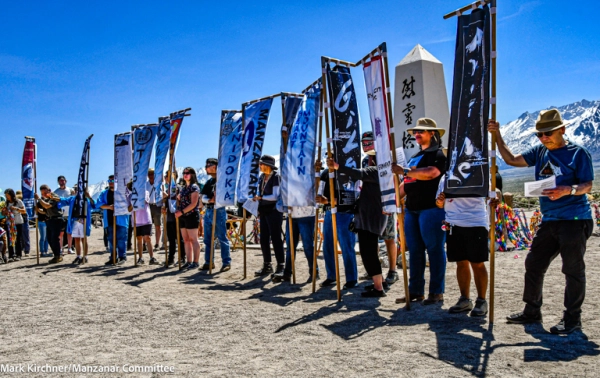
MANZANAR NATIONAL HISTORIC SITE, NEAR LONE PINE, CA — For thirty-nine years, the annual Manzanar Pilgrimage has brought a diversity of faces and a diversity of voices together at the site of one of ten concentration camps that imprisoned over 110,000 Americans of Japanese ancestry during World War II in what is commonly acknowledged as a gross violation of their civil rights.

On April 26, the 39th Annual Manzanar Pilgrimage was no exception and in recent years, that diversity has taken on added significance, both in terms of ethnicity as well as in generations in attendance.

For those who were imprisoned at Manzanar, or in other camps during World War II, the Pilgrimage continues to be a way to honor those who endured life behind the barbed wire. But it also serves as a means to help them cope with the emotional scars caused by their wartime experience.

“I remember Pilgrimages that were seventy-five percent former internees,” said Bruce Embrey, Co-Chair of the Manzanar Committee, the non-profit organization that sponsors the annual Pilgrimage. “Very few young people. I remember when there were mostly young people, but then it changed. It was this pilgrimage to understand and honor, but also this catharsis. My aunt just told her story publicly for the first time last night.”

“[The Pilgrimage] is the expression of that,” added Embrey, whose mother, the late Sue Kunitomi Embrey, was one of the founders of the Manzanar Pilgrimage and is credited with being the driving force behind the preservation of the area and the creation of the Manzanar National Historic Site. “This is cathartic for them. They come here to honor their families and honor the strength of their family enduring this. It helps them understand and makes sense of their lives and what they experienced growing up—the sense of humiliation, and in some cases, the fear of anyone in uniform.”

The diversity of people involved with Manzanar and the Manzanar Pilgrimage also includes residents of the Owens Valley, where Manzanar is located. But during the long process of gaining National Historic Site status for Manzanar, and even shortly thereafter, a vocal group of local residents did not want to be part of that diversity.

“There were some long-term local families who saw this as obscuring their family history,” said Bill Michael, former director of the Eastern California Museum in Independence, California, about five miles north of Manzanar. “I remember when a group of locals, mostly an American Legion group, called a meeting. Ross Hopkins [the first Superintendent of the Manzanar National Historic Site] and I sat down with them. They demanded that we remove our exhibit on Manzanar from the Eastern California Museum. They said it doesn’t belong here, it’s wrong, and we want to you remove it and what’s more, we’re going to do everything we can to make that happen.”

“I said that we feel that this is an important part of this area’s history and our job is to tell the history,” added Michael, who served as vice chair of the Manzanar National Historic Site Advisory Commission and was a key figure in the movement to preserve and protect the site since the mid-1980’s. “So there were some interesting times.”

But not all of those times were negative.

“Some of the things that I still remember are the power of personal experiences of people who weren’t necessarily in the camps but were affected by one,” said Michael. “I still remember one where I really, really learned something, where a retired local came in. He’d grown up on farms in the Fresno area. He’d never been here before, but with his visit to the site and to the museum, he learned what happened to all of his childhood friends. His experience was that one day, the families around him and his friends—the kids he played with every day and went to school with—they were just gone.”

“This was a dozen years ago, at least,” added Michael. “He was in tears recalling this and finally understanding what happened to the people around him.”

“I’ve had the experience of local people coming to the counter, they sometimes had some not very favorable comments about the camp, the experience and the effort to preserve it. This gentleman made me realize that everybody’s experience is individual and different. The power of that guy’s visit had a real long impact on me. It made me realize that this site was not just for the people who were in it, but how important it is for the fabric of American History and culture.”

Nevertheless, the movement to create the Manzanar National Historic Site was certainly a struggle.

“Struggle would certainly be an understatement,” Michael emphasized. “It was really tough. The fact that the guy who was the head of the National Park Service at the time, William Penn Mott, had been head of the California State Park system when they failed to create the site—his own feelings on the site were that nobody wanted it, so why are we doing it?”

One look at the crowd at the Pilgrimage on April 26 provided the answer.

“It’s incredible that we have all these young people and all kinds, not just Japanese Americans,” said Embrey. “A lot of college students.”

To be sure, there was a large contingent of youth present at the Pilgrimage and at the Manzanar At Dusk program held later that afternoon, and the reasons for their participation were both personal and community-based.

“I’ve grown up my whole life hearing about the internment camps and the legacy it has left on my family and on the Japanese American community,” said Annie Kim Noguchi, a 19-year-old student from Florin, California. “I hear my grandparents and all my older relatives talk about it, so that was one of the main reasons.”

While Noguchi, who made the journey with a large contingent of Japanese Americans, Muslim Americans and others, on a trip sponsored by the Florin chapter of the Japanese American Citizens League, came from Northern California, students from Southern California expressed similar reasons for making the trip.

“[Members of the UCLA Nikkei Student Union] definitely relate to Manzanar,” said Mickie Okamoto, a UCLA senior who is the organization’s president and was one of the speakers at the Pilgrimage. “A lot of us have grandparents who were interned here. For me, one of my grandparents was interned at Manzanar, so I have a connection there. It’s also a way to connect to Japanese American history. A lot of our members feel the same way.”

“Everybody realizes how important the internment experience was for Japanese Americans,” added Okamoto. “I think it’s something that anybody, whether they have a personal connection or not, doesn’t want to see disappear. They see it as something worth keeping. If we don’t come out to this, then how do we remember Manzanar?”

Okamoto poses a crucial question that strikes at the core of why the Manzanar